|
RAD AMC-102
High Speed Media Converter and Repeater
Call us for
Pre-sales and discount pricing
301-924-7400 Ext 17 or 18 for Sales
Support

|
RAD AMC-102 High Speed Media Converter and Repeater
Features
Modular media converter and repeater
Supports single mode fiber, multimode fiber, single mode in single fiber,
STP, UTP and coax
Fiber Optic or copper repeater (in retimed conversion mode)
Complies with ATM Forum specifications
Protocols supported in retimed mode:
- 51 Mbps OC-1
- 100 Mbps TAXI
- 155 Mbps OC-3
- 155 Mbps STM-1/STS-3c over UTP/STP
- FDDI
- 100Base-Tx or 100Base-Fx (Fast Ethernet)
Transparent media conversion of up to 155 Mbps
Transparent mode supports any two-level optical protocols including:
- Ethernet
- Token Ring
- Any protocols supported in retimed mode
Bridging of Ethernet and Fast Ethernet
Multiple connector types are available for both electrical and optical
interfaces
RETIMED MODULES
AMC-101 provides retimed media conversion for the following ATM interfaces:
STS-1 (51 Mbps), TAXI (100 Mbps) and STM-1/STS-3C (155 Mbps) over optical
and electrical interfaces. Retimed conversion is also available for FDDI and
Fast Ethernet (100 Mbps).
The retimed modules provide rate selection for 51, 100 or 155 Mbps. When set
to one of these rates, the retimed module regenerates and reclocks the
incoming signal and acts as an ATM, FDDI or Fast Ethernet repeater.
TRANSPARENT MODULES
AMC-101 provides transparent conversion for any two-level optical protocol.
Transparent modules are recommended for short distances and for all
applications performed at less than 100 Mbps.
AMC-101 can be used to convert between different media (see Figure 1). A
single AMC-101 converter with different media modules is used to connect two
devices operating with dissimilar fiber or electrical interfaces. Either
transparent or retimed modules can be used.
AMC-101 can be used as a repeater for extended distances (see Figure 2). A
single AMC-101 can be used as a fiber optic or copper repeater for ATM or
FDDI and Fast Ethernet, when installed with two similar retimed modules (B1
and B2).
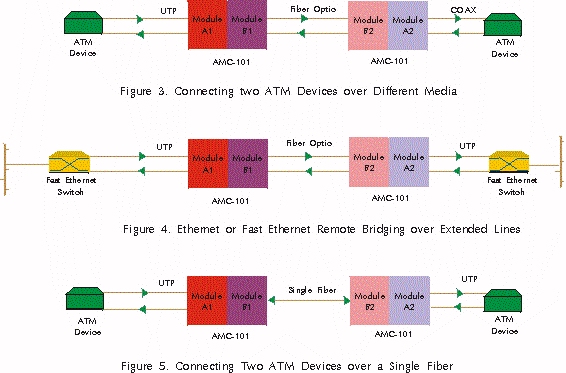
A pair of AMC-101 converters can be used to connect two similar ATM devices
over a different media type using retimed modules B1 and B2 (see Figure 3).
The FDDI and Fast Ethernet (100Base-T) standards apply scrambling to data
when operating over UTP, but do not apply it when operating over fiber. As a
consequence, AMC-101 cannot convert between UTP and fiber for the two
protocols. In this situation, it is recommended that a pair of AMC-101s be
used to convert from UTP to fiber optic and then back to UTP. This extends
the FDDI-UTP (CDDI) and 100Base-T over fiber using retimed modules.
Alternatively, 100BT/B and 100BT/R modules can be used for 100Base-Tx to
100Base-Fx conversion.
AMC-101 can be used in applications of Ethernet or Fast Ethernet remote
bridging over long distances (see Figure 4). Modules A1 and A2 can be
AMC-100BT/B or AMC-10BT/B. Modules B1 and B2 can be any transparent (for
Ethernet) or retimed (for Fast Ethernet) optical modules.
AMC-101 can be used to connect two ATM devices over a single fiber (see
Figure 5).
A pair of AMC-101s is used to connect two ATM devices where the physical
link is a single fiber. In this application, modules B1 and B2 are using the
WDM technology, where the transmit signal is at a different wavelength than
the receive signal. Modules A1 and A2 can be any modules.
Modules B1 and B2 can be a pair of AMC-M/SM/**/SF1 and AMC-M/SM/**/SF2.
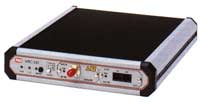
AMC-101 is supplied as a standalone unit. Special hardware for mounting
either a single unit or two units side-by-side in a 19" rack can be ordered
separately (see Ordering).
ALARMS CONNECTOR
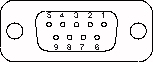
A dry circuit with a 9-pin D-type connector on the rear panel, has been
added to the unit to signal minor and major alarms. The dry contact circuit
is used to signal the following alarms:
- RED ALARM - Power Failure (DC voltage on board)
- YELLOW ALARM - Signal Detect Failure (to any of the unit modules)
- CONFIG ALARM - Improper Configuration (incompatible modules and/or data
rates selected)
Three pins are dedicated for each alarm: Common (COM), OK and FAIL. The COM
pin is the input for each alarm. The user can drive the COM pin with any
signal (0 to 5V). If the signal is received OK, the COM pin is connected to
its corresponding OK pin; If there is a failure, the COM pin is connected to
its corresponding FAIL pin (See Figure 7 and Table 1 for the connector pin
assignments).
|
AMC-101 Applications
1)

Figure 1
- Conversion between Differnet Media

Figure 2
- Repeater Application
(Using only retimed modules for protocols running at 155, 100 or 51 Mbps)

Figure 7. Connector Pin Assignment

Table 1. Connector Pin Assignment Table
| |
PIN TYPE |
| ALARM TYPE |
COM |
OK |
FAIL |
| RED |
9 |
4 |
5 |
| YELLOW |
3 |
8 |
7 |
| CONFIG |
6 |
2 |
1 |
Table 2. Bridging Modules
| Module Name |
Protocols Supported |
Cable Type |
Connector Type |
Range |
Impedance |
| 10BT/B |
Ethernet |
UTP Cat 5 |
Shielded RJ-45 |
100m |
100
 |
| 100BT/B |
Fast Ethernet |
UTP Cat 5 |
Shielded RJ-45 |
80m |
100
 |
| 100BT/R |
Fast Ethernet |
UTP Cat 5 |
Shielded RJ-45 |
80m |
100
 |
* Remote Ethernet bridge module
** Remote Fast Ethernet bridge module
*** Media converter for Fast Ethernet (Tx to Fx)
Table 3. Optical Module Characteristics
| Module Name |
Protocols Supported |
Fiber Type (Wavelength) |
Connector Type |
Typical Distance |
Dynamic Range |
Optical Power (typical) |
Sensitivity |
| MM/ST/85* |
Token Ring, Ethernet
only, FDDI, Fast Ethernet |
62.5/125 (850 nm) |
ST |
2 km / 1.2 mile |
18 dB |
-18 dBm |
-30 dBm |
| MM/SC/13** |
TAXI, FDDI, Fast
Ethernet, STS-1, STS-3c/STM-1 |
62.5/125 (1300 nm) |
SC |
2 km / 1.2 mile |
17 dB |
-18 dBm |
-31 dBm |
| MM/ST/13** |
TAXI, FDDI, Fast
Ethernet, STS-1, STS-3c/STM-1 |
62.5/125 (1300 nm) |
ST |
2 km / 1.2 mile |
17 dB |
-18 dBm |
-31 dBm |
| SF1/FC*** |
TAXI, FDDI, Fast
Ethernet, STS-1, STS-3c/STM-1 |
9/125 Transmit 1300 nm
Receive 1550 nm |
FC-PC (Single Strand) |
40 km / 25 mile |
28 dB |
-12 dBm |
-29 dBm |
| SF2/FC*** |
TAXI, FDDI, Fast
Ethernet, STS-1, STS-3c/STM-1 |
9/125 Transmit 1550 nm
Receive 1300 nm |
FC-PC (Single Strand) |
40 km / 25 mile |
28 dB |
-12 dBm |
-29 dBm |
| SF1/ST*** |
TAXI, FDDI, Fast
Ethernet, STS-1, STS-3c/STM-1 |
9/125 Transmit 1300 nm
Receive 1550 nm |
ST (Single Strand) |
40 km / 25 mile |
28 dB |
-12 dBm |
-29 dBm |
| SF2/ST*** |
TAXI, FDDI, Fast
Ethernet, STS-1, STS-3c/STM-1 |
9/125 Transmit 1550 nm
Receive 1300 nm |
ST (Single Strand) |
40 km / 25 mile |
28 dB |
-12 dBm |
-29 dBm |
| SM/FC/13** |
TAXI, FDDI, Fast
Ethernet, STS-1, STS-3c/STM-1 |
9/125 (1300 nm) |
FC-PC |
25 km / 16 mile |
30 dB |
-18 dBm |
-31 dBm |
| SM/FC/13L** |
TAXI, FDDI, Fast
Ethernet, STS-1, STS-3c/STM-1 |
9/125 (1300 nm) |
FC-PC |
40 km / 25 mile |
30 dB |
-10 dBm |
-31 dBm |
| SM/FC/13LH** (LASER) |
TAXI, FDDI, Fast
Ethernet, STS-1, STS-3c/STM-1 |
9/125 (1300 nm) |
FC-PC |
60 km / 37 mile |
33 dB |
-2 dBm |
-34 dBm |
| SM/FC/15LH** (LASER) |
TAXI, FDDI, Fast
Ethernet, STS-1, STS-3c/STM-1 |
9/125 (1550 nm) |
FC-PC |
110 km / 68 mile |
33 dB |
-1 dBm |
-34 dBm |
| SM/SC/13L** (LASER) |
TAXI, FDDI, Fast
Ethernet, STS-1, STS-3c/STM-1 |
9/125 (1300 nm) |
SC |
40 km / 25 mile |
30 dB |
-10 dBm |
-31 dBm |
| SM/ST/13** |
TAXI, FDDI, Fast
Ethernet, STS-1, STS-3c/STM-1 |
9/125 (1300 nm) |
ST |
25 km / 16 mile |
30 dB |
-18 dBm |
-31 dBm |
| SM/ST/13L** (LASER) |
TAXI, FDDI, Fast
Ethernet, STS-1, STS-3c/STM-1 |
9/125 (1300 nm) |
ST |
40 km / 25 mile |
30 dB |
-10 dBm |
-31 dBm |
| SM/ST/13LH** (LASER) |
TAXI, FDDI, Fast
Ethernet, STS-1, STS-3c/STM-1 |
9/125 (1300 nm) |
ST |
60 km / 37 mile |
33 dB |
-2 dBm |
-34 dBm |
| SM/ST/15L** (LASER) |
TAXI, FDDI, Fast
Ethernet, STS-1, STS-3c/STM-1 |
9/125 (1550 nm) |
ST |
50 km / 31 mile |
30 dB |
-10 dBm |
-31 dBm |
| SM/ST/15LH** (LASER) |
TAXI, FDDI, Fast
Ethernet, STS-1, STS-3c/STM-1 |
9/125 (1550 nm) |
ST |
110 km / 68 mile |
33 dB |
-1 dBm |
-34 dBm |
* Transparent only
** Data rates are switch selectable from the front panel
*** Retimed only
Note: Typical distances based on attenuation of 0.4 dB/km for 1300 nm
modules and 0.25 dB/km for 1550 nm modules
Table 4. Electrical (Copper) Module Characteristics
| Module Name |
Protocols Supported |
Cable Type |
Connector Type |
Range |
Impedance |
| UTP/155* |
STS-3c |
UTP Cat 5 |
Shielded RJ-45 |
100m |
100 |
| STP/155 * |
STS-3c |
STP Type 1 |
DB-9 |
100m |
150 |
| UTP/100* |
FDDI |
UTP Cat 5 |
Shielded RJ-45 |
100m |
100 |
| CX/BNC/155** |
STS-3C, STM-1 |
Coax |
BNC |
12.7 dB |
75 |
| CX/DIN/155** |
STS-3C, STM-1 |
Coax |
DIN 47295 1.6/5.6 Coaxial
connector |
12.7 dB |
75 |
* 50m in transparent module
** At 78 MHz, according to square rood of frequency law; 150m is attainable
when using RG-59 B/U
RAD Products
For discount pricing on RAD Data
Communications
email us at sales@data-connect.com
or call 301-924-7400 Ext 17 or 18 for sales

|