Patton
Electronics 2089
Interface Powered, RS-232
(EIA-574) to RS-485 Interface Converter
|
Patton Part # |
Black Box Part # |
Description |
|
2089F |
IC620A-F |
RS232-485 Converter DB9F-Term Bl |
|
2089F RJ11 |
IC623A-F |
RS232-485 Converter DB9F-RJ11 |
|
2089F RJ45 |
IC624A-F |
RS232-485 Converter DB9M-RJ45 |
|
2089M |
IC620A-M |
RS232-485 Converter DB9M-Term Bl |
|
2089M RJ45 |
IC624A-M |
RS232-485 Converter DB9F-RJ45 |
|
2089M RJ11 |
IC623A-M |
RS232-485 Converter DB9F-RJ11 |
|
|
|
|
|
Patton Electronics 2089
|
|
Interface Powered, RS-232
(EIA-574) to RS-485 Interface Converter (with Handshaking)
|
|
Connect RS-485 Data
Acquisition & Control Equipment to a DB-9 (RS-232) Equipped PC or
Workstation
|
|
|
|
|
|
|
|
|
Features & Benefits |
- Fully Conforms to the EIA RS-485 Standard
- Data Rates to 115,200 bps
- Range Up to 9 Miles (14.5 Km)
- No AC Power or Batteries Required
- Up to 50 Terminal Drops in a Multipoint Polling Environment
- 600 Watts of Silicon Avalanche Diode Surge Protection - Standard
|
|
|
|
Overview |
|
|
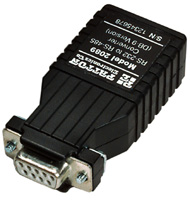
The Model 2089
is Patton’s first high speed EIA-574 (RS-232 on a DB-9) to RS-485
interface converter. Supporting async data rates to 115.2 kbps over one or
two unconditioned twisted pair, the Model 2089 passes one control signal
in each direction. The Model 2089 can handle up to 50 terminal drops in a
multipoint polling environment; yet it is small enough to plug directly
into a DB-9 serial port...and requires no AC power or batteries for
operation. The Model 2089 has five configuration parameters, allowing the
unit to be “fine tuned” to a variety of point-to-point or multipoint
applications. Silicon Avalanche Diode surge protection is standard as
well. Amazing!
|
Transmission Format: Asynchronous
Data Rate: Up to 115,200 bps
Range: Up to 9 miles (14.5km)
EIA-574 Interface: DB-9, male or female
RS-485 Interface Options: RJ-11 or RJ-45 jack, terminal block with
strain relief
Transmit Line: 2, 4 wire unconditioned twisted pair
Transmit Mode: 4-wire, full or half duplex; 2-wire half duplex
Control Signals: DSR turns “ON” immediately after the terminal
raises DTR; DCD turns “ON” after recognizing the receive signal from the
line; CTS turns “ON” after the terminal raises RTS.
RTS/CTS Delay: 0 or 8 msec
Carrier: The carrier is switch selected either continuous operation
or controlled by RTS
Surge Protection: 600W power dissipation at 1 mS
Power: Draws operating power from EIA-574 data and control signals;
no AC power or batteries required.
Temperature: 32º to 122º F (0º to 50º C)
Size: 2.50" x 1.20" x 0.75" (6.4 x 3.0 x 1.9 cm)
|
Patton Products
|