
The Cisco 3600 series is a multifunction platform that combines dial access, routing, and LAN-to-LAN services and multi-service integration of voice, video and data in the same device. The Cisco 3600 series includes the Cisco 3660, the Cisco 3640, and Cisco 3620 multi-service platforms. As modular solutions the Cisco 3660, the Cisco 3640, and Cisco 3620 have the flexibility to meet both current and future connectivity requirements. The Cisco 3600 series is fully supported by Cisco IOS software, which includes analog and digital voice capability, ATM access with T1/E1 IMA or OC-3 interfaces, dial-up connectivity, LAN-to-LAN routing, data and access security, WAN optimization, and multimedia features.
The Cisco 3660 has six network module slots; The Cisco 3640 has four network module slots; the Cisco 3620 has two slots. Each network module slot accepts a variety of network module interface cards, including LAN and WAN mixed media cards supporting Ethernet, Fast Ethernet, Token Ring, and a variety of WAN technologies. These cards provide the foundation of LAN and WAN connectivity on a single, modular, network module. Additional applications are supported with a series of network module cards offering digital modems, asynchronous and synchronous serial, ISDN PRI, and ISDN BRI interfaces. In addition to the 6 network module slots the Cisco 3660 has 2 internal Advanced Integration Module (AIM) slots for applications such as hardware accelerated compression and the chassis incorporates 1 or optionally 2 integrated 10/100 (Ethernet/Fast Ethernet) ports.
The Cisco 3600 series shares network modules, WAN Interface Cards, and Voice Interface Cards with the Cisco 2600 series. The Cisco 3600 series shares WAN Interface Cards with the Cisco 1600 and Cisco 1700 series.
Figure 18-8: Cisco 3660 Router Rear View
Figure 18-9: Cisco 3640 Router Rear View
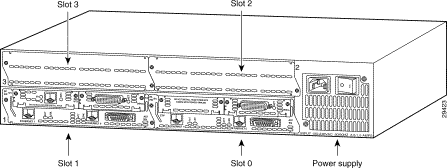
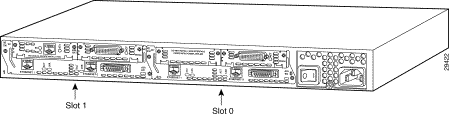
Figure 18-10: Cisco 3620 Router Rear View
The Cisco 3660, Cisco 3640, and Cisco 3620 routers support the following network applications and services:
Analog and digital voice services
The voice/fax network modules for the Cisco 2600 and Cisco 3600 series multiservice access routers enable packet voice technologies including VoIP and VoFR. Cisco`s voice solutions provide the means for integrating both voice and data within a single network and allow users to take advantage of services, such as toll-bypass, without sacrificing voice quality. The digital T1/E1 Packet Voice Trunk Network Module provides a flexible and scalable T1/E1 voice solution and supports up to 60 voice channels in a single network module. The analog voice/fax network modules slide into Cisco 2600 and 3600 chassis slots and contain either one or two voice interface card (VIC) slots. The VICs currently available are two-port foreign exchange station (FXS), foreign exchange office (FXO), E&M 2-wire and 4-wire interfaces and a basic rate interface (BRI). The voice modules support all major industry codecs including G.711, G.723, G.726, G.728, G.729 and G.729a/b for customized solutions and to meet the need for high voice quality and bandwidth efficiency
ATM networking services
Four new multiport T1/E1 ATM network modules with Inverse Multiplexing over ATM (IMA) and 3 ATM OC-3 network module are now available for the 3600 series multiservice access platforms. These new multiport ATM modules allow service provider and enterprise customers to cost-effectively increase bandwidth, extending multiservice capabilities to remote-branch-office locations through ATM. These network modules support a robust set of ATM features including UBR, VBR-rt, VBR-nrt, and ABR ATM class of services, ATM Forum User Network Interface (UNI) 3.0, UNI 3.1, and UNI 4.0 signaling, Permanent Virtual Circuits (PVCs) and Switched Virtual Circuits (SVCs), and ATM Adaptation Layer 5 (AAL5) to name a few.
Dial-up services
The Cisco 3600 is a mid-range dial-up platform that fits between Cisco`s AccessPath and AS5300 products at the high end and the Cisco 2500 series access servers at the low end. Mixed-mode and high density ISDN and asynchronous configurations offer substantial flexibility in dial-up applications. Integrated digital modems (with support for PRI, BRI, CT1 and R2) and new integrated analog modems further enhance the dial access flexibility and scalability of the Cisco 3600.
ISDN PRI networks
The Cisco 3600 series offers high levels of cost effective ISDN PRI concentration. A Cisco 3640 configured with a Mixed Media LAN/ISDN PRI network module and three 2-port ISDN PRI network modules supports up to 186 (T1) or 240 (E1) B channels. This is a powerful and cost effective way to aggregate many branch offices and telecommuters onto one corporate network.
ISDN BRI networks
For areas of the world where ISDN BRI services are more widely available or cost effective, the Cisco 3600 series supports many BRI interfaces. Configured with a LAN network module and three 8-port network modules, a Cisco 3640 connects up to 48 B channels. In this way, one system provides high-density BRI interface dial-up support and local LAN and WAN routing connectivity.
Serial networks
With support for up to 48 synchronous serial interfaces on the Cisco 3660, the Cisco 3600 series and its RISC processor are the perfect complement to the Cisco 2600, 2500, 1700, and 1600 series. The Cisco 3600`s higher performance and modular design are appropriate for locations needing support for multiple T1/E1 links or the ability to change configurations in the future.
Mixed WAN services
Many corporate environments require support for a mixture of ISDN PRI, ISDN BRI, asynchronous serial, and synchronous serial connections. The Cisco 3600 series is ideal for this scenario. It allows migration between interfaces or simultaneous support of several technologies.
Multiservice access solutions and applications
The three Cisco 3600 models allow new levels of connectivity and performance for branch offices with their scalable size, slot density, and cost. Combinations of network modules provide new opportunities for branch offices needing more than a fixed-configuration solution. The Cisco 3620, for example, provides multiple LAN access server support for asynchronous, ISDN, analog modem and digital modem environments, which complements the Cisco 2500 series access servers. Alternatively, a Cisco 3620 adds multiple LAN capabilities to branch bank environments needing to assimilate legacy serial devices, connecting them all to a high-speed Frame Relay network.
LAN-to-LAN services
Consistent with its other capabilities, the Cisco 3600 series offers midrange LAN-to-LAN connectivity for branch offices needing a flexible modular platform. The Cisco 2500 series, with a multitude of fixed configurations, offers cost effective branch office solutions including integrated routers and hubs, single and dual LAN routers, and multiple serial routers.
The Cisco 3660, Cisco 3640, and Cisco 3620 routers are 6-, 4- and 2-slot multiservice access routers, respectively, whose LAN and WAN connections are configured by means of interchangeable network modules and WAN interface cards. The Cisco 3660 also incorporates 1 or optionally 2 integrated 10/100 (Ethernet/Fast Ethernet) ports.The following network modules are available for the Cisco 3660, Cisco 3640, and Cisco 3620 routers:
Analog and Digital (T1) Voice Network Modules
Single-Port High-Speed Serial Interface (HSSI)
ATM 25 Mbps Network Module
ATM OC3 155 Mbps Network Module
6, 12, 18, 24 and 30 digital modem network modules
LAN with modular WAN (WAN Interface Cards)
8 and 16 analog modem network modules
Channelized T1, ISDN PRI and E1 ISDN PRI network modules
Combined FastEthernet and PRI network modules
4- and 8-port ISDN BRI network modules
16- and 32-port asynchronous network modules
4- and 8-port synchronous/asynchronous network modules
1- and 4-port Ethernet network modules
1-port Fast Ethernet (10/100) network modules (100BaseT - "TX" and Fiber - "FX")
8- and 16-port analog modem modules
4-port serial network module
Compression network module (Cisco 3620 and Cisco 3640, AIM for the Cisco 3660)
In addition the Cisco 3660 supports 2 internal AIM slots. The Data Compression Advanced Integration Module (AIM) for the Cisco 3660 Series delivers a cost-effective option for reducing recurring wide-area network (WAN) costs and maximizing the benefit of the advanced bandwidth management features of Cisco IOS. The Data Compression AIM takes advantage of either of the two available Cisco 3660 internal AIM slots, ensuring that external slots remain available for components such as integrated analog voice/fax, digital voice/fax, ATM, channel service unit/digital service units (CSU/DSUs), analog and digital modems.
The figure below shows how a vacant chassis slot on the Cisco 3640 accepts a mixed media network module, which in turn accepts a WAN interface card.
Figure 18-11: Relationship Between Cisco 3600 Series Hardware Devices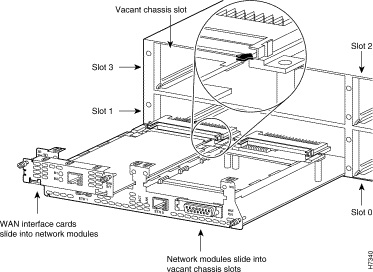
|
Description |
Cisco 3620 |
Cisco 3640 |
Cisco 3660 |
|---|---|---|---|
|
Supported network interfaces |
Ethernet Fast Ethernet Token Ring Asynchronous Synchronous serial High Speed Serial Interface ISDN BRI (ST and U interfaces) Channelized T1/ISDN PRI (with and without CSU) Channelized E1/ISDN PRI (balanced and unbalanced) Digital Modems Analog Modems Voice ATM 25 Mbps ATM OC3 Multiport T1/E1 ATM with IMA (Inverse Multiplexing over ATM) |
Same as Cisco 3620 |
Same as Cisco 3620 |
|
Supported Cisco IOS software |
Release 11.1 AA, Release 11.2 P, 11.3, and 11.3T, 12.0, 12.0T |
Same as Cisco 3620 |
Release 12.0(5)T |
|
Flash Memory |
8 MB of Flash memory (SIMM), expandable to 32 MB. PCMCIA Flash memory cards are also supported by each model, available in 4 to 16 MB sizes. |
Same as Cisco 3620 |
8 MB of Flash in the enterprise models (3661-AC, 3661-DC, 3662-AC, 3662-DC) and 16 MB in the telco models (3662-AC-CO, 3662-DC-CO) upgradable to 64 MB |
|
DRAM memory (system and packet) |
32 MB of DRAM memory expandable to 64 MB. |
32 MB of DRAM memory, expandable to 128 MB. |
32 MB of SDRAM for both enterprise and telco models, upgradable to 256 MB |
|
Network module slots |
2 |
4 |
6 |
|
Processor type |
80 MHz IDT R4700 RISC |
100 MHz IDT R4700 RISC |
225 MHz RISC QED RM5271 |
|
Standard components |
2 PCMCIA slots High-speed console and auxiliary ports Rack- and wall-mount kit Power supply and cord Console Cable |
Same as Cisco 3620 |
Same as Cisco 3620 |
|
Description |
Cisco 3620 |
Cisco 3640 |
Cisco 3660 |
|---|---|---|---|
|
Input Voltage, AC |
100 to 240 VAC, autoranging |
Same as Cisco 3620 |
Same as Cisco 3620 |
|
Input Voltage, DC |
38 to 72 VDC |
Same as Cisco 3620 |
Same as Cisco 3620 |
|
Current, AC |
1.0A |
2.0A |
2.0A |
|
Current, DC |
2.5A |
5.0A |
8.0A |
|
Frequency |
50 to 60 Hz |
Same as Cisco 3620 |
Same as Cisco 3620 |
|
Max. power dissipation |
60W |
140W |
250W |
|
Description |
Cisco 3620 |
Cisco 3640 |
Cisco 3660 |
|---|---|---|---|
|
Dimensions (H x W x D) |
1.75 x 17.5 x 13.5 in. (4.4 x 44.5 x 34.2 cm) |
3.44 x 17.5 x 15.7 in. (8.7 x 44.5 x 40.01 cm) |
8.7 x 17.5 x 11.8 in. (22.1 x 44.5 x 30 cm) |
|
Weight (average shipping) |
25 lb (13.6 kg), includes chassis and 4 network modules |
Same as Cisco 3620 |
43 lb (19.55 kg) includes chassis and 6 network modules |
|
Operating humidity, noncondensing |
5 to 95% |
Same as Cisco 3620 |
Same as Cisco 3620 |
|
Operating temperature |
32 to 104°F (0 to 40°C) |
Same as Cisco 3620 |
Same as Cisco 3620 |
|
Description |
Cisco 3620 |
Cisco 3640 |
Cisco 3660 |
|---|---|---|---|
|
Regulatory compliance |
FCC Part 15 Class B. For additional compliance information, refer to the 3600 Series Public Network Certification document. |
Same as Cisco 3620 |
Same as Cisco 3620 |
The Cisco 3620/40 uses two types of replaceable or upgradeable memory: DRAM memory and Flash memory. Both types of memory are implemented with SIMMs. Each router has two Flash SIMM sockets and four DRAM SIMM sockets. In the standard Flash memory configuration, the first socket contains a 8 MB Flash SIMM, and the second socket is empty. You can upgrade the Flash memory to 32 MB on both routers. Each Cisco 3600 router ships standard with 32 MB of DRAM. The Cisco 3640 is expandable to 128 MB of DRAM. The Cisco 3620 is expandable to 64 MB of DRAM.
The Cisco 3660 series uses two types of replaceable or upgradeable memory: SDRAM memory and Flash memory. Flash memory is implemented with SIMMs whereas SDRAM memory uses DIMMS. The 3660 has two Flash SIMM sockets and two SDRAM DIMM sockets. In the standard Flash memory configuration, the first socket contains a 8 MB Flash SIMM, and the second socket is empty. You can upgrade the Flash memory to 64 MB on a 3660 router. Each Cisco 3600 router ships standard with 32 MB of SDRAM and is upgradable to 256 MB of SDRAM.
The Cisco 3600 series routers use a DRAM memory configuration that is different from other Cisco routers. Unlike the Cisco 4000 series routers, for example, which have separate physical locations for processor memory and packet memory, the Cisco 3600 series routers use one pool of DRAM memory. The DRAM is partitioned into processor memory and packet memory areas. For example, the memory of a 16 MB DRAM configuration is split into 12 MB for processor memory and 4 MB for the packet memory.
The Cisco 3600 allows you to load new system images using a PCMCIA Flash memory card. You can also load images from a local or remote PC through the console or auxiliary ports using the Xmodem or Ymodem protocols.
|
Description |
Specification |
|---|---|
|
Supported Cisco IOS software |
Cisco 3620/40: Release 11.1 AA, Release 11.2 P, 11.3, and 11.3T, 12.0, 12.0T Cisco 3660: Release 12.0(5)T |
For configuration and ordering information for network modules, WAN interface cards, and voice/fax interface cards for the Cisco 3600 series routers, see the
jump to Related Cisco page